Registered Agent vs. Virtual Mailbox: What’s the Difference?
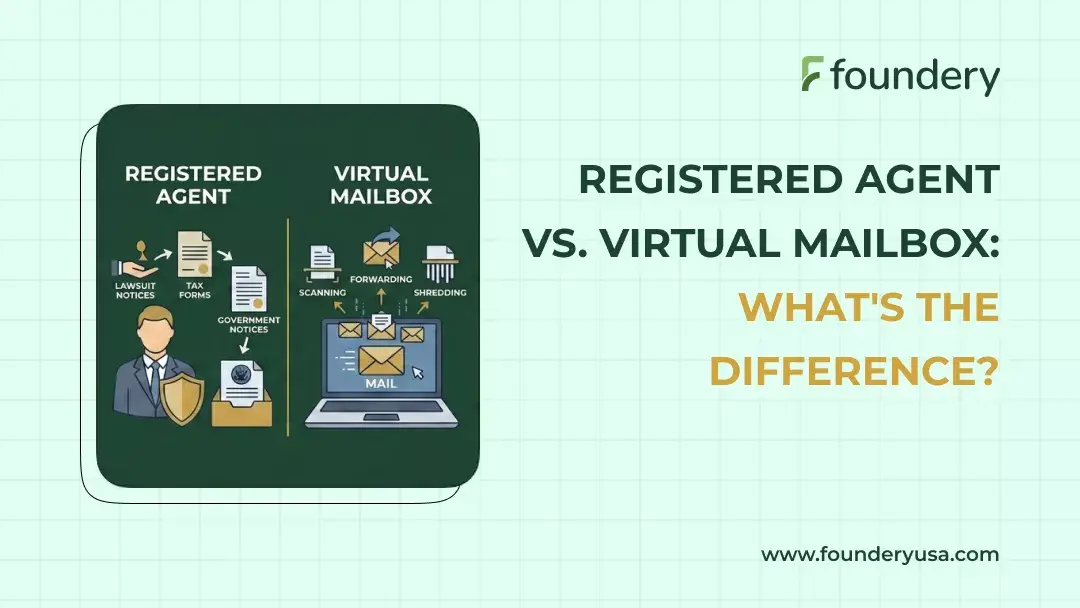
A registered agent and a virtual mailbox are two of the most commonly confused services in business formation, and the confusion is understandable. Both give your business an address and keep your home address off public paperwork. Both show up during the same conversation when you’re forming an LLC or corporation. But they exist for entirely different reasons, and mixing them up can cost you a lawsuit you never knew you had.
A registered agent is a legal requirement that receives service of process and official state correspondence on your business’s behalf. A virtual mailbox is an optional service that gives you a real street address to receive, scan, and forward everyday business mail. One is about legal compliance. The other is about privacy and professionalism. Most growing businesses eventually benefit from using both.
Here’s exactly how they differ, when each one applies, and how to decide what your business actually needs.
Key Takeaways
- A registered agent is legally required for every LLC and corporation; a virtual mailbox is optional.
- A registered agent handles legal documents and service of process; a virtual mailbox handles everyday business correspondence.
- A virtual mailbox cannot serve as your registered agent unless the provider is specifically licensed as a registered agent in that state.
- Use your registered agent’s address only on state compliance filings; use your virtual mailbox or monitored business address for the IRS, banking, and marketing.
- Multi-state businesses need a registered agent in every state where they’re registered or foreign qualified, but typically only need one centralized virtual mailbox.
- Most growing businesses need both: a registered agent for compliance and legal coverage, and a virtual mailbox for privacy, as well as professionalism.
What Is a Registered Agent?
A registered agent, also called a statutory agent or resident agent, is a person or company officially designated to receive legal documents and government correspondence on behalf of a business. This includes service of process (the formal delivery of a lawsuit), compliance notices from the Secretary of State, and certain tax correspondence.
Nearly every U.S. state legally requires LLCs and corporations to name a registered agent as part of formation. If you’re forming an llc, choosing a registered agent is one of the important steps to complete when establishing your business. This isn’t a suggestion buried in the fine print, it’s written into state statute, and your registered agent’s name and address are listed directly on your Articles of Organization (for an LLC) or Articles of Incorporation (for a corporation).
A registered agent must:
- Maintain a physical street address in the state of formation, a P.O. Box does not qualify.
- Be available during standard business hours to accept documents in person.
- Be a resident individual, an employee of the business, or a licensed registered agent service.
If your business operates in more than one state, you’ll typically need a registered agent in every state where you’re registered or foreign qualified to do business.
If your registered agent misses a delivery, because the address is wrong, no one is available, or the “agent” was never actually authorized to receive legal documents, you can lose a lawsuit by default without ever knowing it was filed. Courts don’t wait for you to check your mail. A missed service of process can result in a default judgment, and a lapsed registered agent can put your business out of good standing with the state, which can affect everything from bank loans to the ability to sue in that state’s courts.
What Is a Virtual Mailbox?
A virtual mailbox is a service that gives your business a real, physical street address, not a P.O. Box, where you can receive mail and packages without anyone needing to be physically present. Most providers scan incoming mail and upload it to an online dashboard, so you can view, forward, shred, or archive each piece remotely.
Unlike a registered agent, a virtual mailbox is not a legal requirement. Nothing in state law says your business needs one. It serves a different service entirely: looking established and keeping your home address off public-facing materials.
A virtual mailbox is typically used for:
- General business correspondence and client mail
- Vendor invoices and supplier communication
- A professional business mailing address on your website, business cards, and marketing materials
- Package and mail consolidation for remote teams, freelancers, and digital nomads
It’s especially popular with home-based business owners who don’t want their personal address listed publicly, e-commerce sellers who need a consistent shipping/return address, and anyone running a business without a fixed physical office.
Registered Agent vs. Virtual Mailbox: Key Differences
A registered agent satisfies a legal compliance requirement, while a virtual mailbox solves a practical, day-to-day mail-handling problem. They overlap in one respect; both provide an address but that’s where the similarity ends.
| Registered Agent | Virtual Mailbox | |
| Legally required? | Yes, in nearly every state, for every LLC and corporation | No! Entirely optional |
| What it receives | Legal documents, service of process, state compliance notices | Everyday business mail and packages |
| Physical presence rule | Must be physically available during business hours | No occupancy or in-person availability required |
| Address type | Physical in-state address only (no P.O. Boxes) | Real commercial street address, any location |
| Listed on public filings? | Yes; required on Articles of Organization/Incorporation | Optional, used for correspondence, not formation filings |
| Best for | Any registered LLC or corporation | Home-based businesses, remote teams, e-commerce sellers |
Can a Virtual Mailbox Also Serve as Your Registered Agent?
Generally, No! And this is where most of the confusion (and legal risk) actually lives. A registered agent must be formally designated with the state and physically able to accept legal documents. A standard virtual mailbox is built around scanning and forwarding mail on your schedule, not being available to sign for a subpoena the moment a process server shows up.
There’s a narrow exception in this case: some virtual mailbox service providers are licensed as a registered agent service in specific states. If a provider holds that authorization, the same physical location can technically support both functions, but they remain two separate services with two separate designations. Simply having a virtual mailbox with a company does not automatically make that company your registered agent. You’d need to formally appoint them as your agent of record with the Secretary of State, usually as a distinct add-on or service tier.
Before assuming your virtual mailbox provider “covers” your registered agent requirement, confirm:
- Whether the provider is officially registered as a commercial registered agent in your state of formation.
- Whether you’ve formally listed them as your agent of record on your state filing, a mailbox subscription alone does not satisfy the requirement.
- Whether business-hours availability for legal document acceptance is actually part of the service, not just mail scanning.
Which Address Should You Use?
This is where a lot of new business owners get tripped up, because the “right” address depends entirely on the document.
- Articles of Organization / Articles of Incorporation: Use your registered agent’s address in the designated registered agent field. This becomes part of the public record.
- EIN application: Use your actual business mailing address, not your registered agent’s address. The IRS sends tax notices and correspondence to whatever address is on file, and a registered agent address isn’t set up to receive or forward federal tax mail reliably. A virtual mailbox address generally works well here, since it’s a real street address you actively monitor.
- Business bank account applications: Banks may require a physical business or principal address in addition to a mailing address, and acceptance of virtual mailbox addresses varies by institution.
- Website, invoices, and business cards: Use your virtual mailbox or business address, never your registered agent’s address, and never your home address if privacy is a priority.
- Beneficial Ownership Information (BOI) reporting (if applicable): BOI filings under the Corporate Transparency Act ask for a company’s current street address, not necessarily the registered agent’s. Confirm the specific field requirements at the time of filing, since reporting rules and enforcement have shifted; your registered agent service or a qualified professional can confirm current requirements for your entity.
Rule of Thumb: If it’s a legal or compliance document filed with the state, the registered agent address goes there. If it’s anything you’d actually want mailed to you and read promptly, taxes, banking, vendors, clients, use your monitored business or virtual mailbox address instead.
Do You Need Both: Registered Agent and Virtual Mailbox?
For most incorporated businesses, yes. They solve different problems, so using only one typically leaves a gap.
- Home-based entrepreneur: Needs a registered agent to satisfy state law, and a virtual mailbox to keep a home address off public websites, invoices, and marketing.
- Multi-state LLC: Needs a registered agent in every state where it’s formed or foreign qualified, plus a single virtual mailbox to centralize day-to-day correspondence across all of them.
- E-commerce or dropshipping business: Needs a registered agent for compliance, and a virtual mailbox as a consistent, professional return/contact address for customers and marketplaces.
- Solo consultant operating as an LLC in their home state: Can technically serve as their own registered agent if comfortable listing a home address and being available during business hours, but many still add a virtual mailbox purely for privacy and professionalism.
Multi-State Considerations
If your business is registered or foreign qualified in more than one state, your registered agent obligation multiplies, you need a registered agent with a physical address in each state where you’re legally registered to do business, not just your home state. This is a common scenario that growing businesses must comply: a company operating in five states typically needs five separate registered agent designations, even if it uses a single national provider to manage them.
A virtual mailbox doesn’t carry the same multiplication. You generally only need one central virtual mailbox address to consolidate mail, even if your registered agent presence is spread across multiple states. This is one reason many multi-state businesses centralize mail handling through a single virtual mailbox while managing registered agent compliance separately, state by state.
Conclusion
A registered agent and a virtual mailbox may both involve a business address, but they serve very different purposes. Your registered agent handles legal and state compliance matters, while a virtual mailbox helps manage everyday business mail and protect your privacy. For many home-based, remote, and international businesses, using both can provide the right balance of compliance, privacy, and professionalism.
If you’re setting up a U.S. business and aren’t sure which address, registered agent, or formation services you need, Foundery USA can help you navigate the process. Our professional team supports international founders with U.S. company formation, registered agent services, EIN assistance, banking guidance, and ongoing compliance while you can keep focus on building your business.
Frequently Asked Questions
1. Can I use my registered agent’s address as my regular business address?
Generally, No. A registered agent’s address is designated for legal and state compliance mail only. Using it as your regular business address on tax forms, bank accounts, or marketing materials means everyday correspondence could go to an address that isn’t monitored for that purpose, and most registered agent services explicitly advise against it.
2. Does the IRS accept a virtual mailbox address?
Yes, the IRS requires a real, monitored street address for correspondence, and a virtual mailbox typically meets that requirement. What you should avoid is listing your registered agent’s address on IRS forms, since that address is reserved for state legal mail, not federal tax notices.
3. What happens if I don’t have a registered agent?
Your business can fall out of good standing with the state, face administrative penalties, or even miss a legal notice entirely. If service of process is never received because no registered agent was available, a court can enter a default judgment against your business without your knowledge.
4. Can one company provide both services?
Some providers are specifically licensed as a registered agent in a given state in addition to offering virtual mailbox services. If so, the same location can support both services, but they remain separate designations, and you must formally appoint the provider as your registered agent of record with the state; a mailbox subscription alone doesn’t satisfy that requirement.
5. Is a virtual mailbox the same as a virtual office?
Not exactly. A virtual mailbox is focused specifically on mail: receiving, scanning, and forwarding it to you digitally. A virtual office typically bundles that mail handling with additional services like a live receptionist, a local phone number, or access to meeting rooms. If all you need is a professional mailing address, a virtual mailbox alone is usually sufficient.